Seaweed and the Vikings
The Vikings - raiders, traders, explorers and settlers - were people of the coasts. As such, seaweed was woven into how they ate, salted their food, farmed their fields, and even worked iron.
There's few written records from the Viking Age, but between the sagas, old law codes, and modern archaeology, we can start to piece together just how deep that relationship really ran.
Navigate this article
- Seaweed was used in a multitude of ways all along the North Atlantic and the traditional Viking routes.
- Iceland's medieval law code Grágás fined people for taking dulse off someone else's land without permission — proof seaweed was valuable, not just edible.
- "Black salt" made by burning seaweed was such a basic necessity that Norway's Gulating Law let tenant farmers break other rules just to afford it.
- Archaeologists have found charred seaweed remains along nearly every major Viking Age voyage route and settlement, from Norway to Greenland.
- Beyond food and salt, seaweed was also spread as fertilizer and used as a flux in Viking-age ironworking.
Who were the Vikings?
The Viking Age ran roughly from the late 700s to 1050 AD; centuries during which seafarers set sail from modern-day Scandinavia and travelled in every direction: west to the Shetlands, the Faroes, Iceland, eventually Greenland and briefly North America; south along the coasts of Britain, Ireland, and down toward France and Iberia; east along the rivers of Russia and beyond.
Most of them were traders, some explorers and settlers, but many of them famously also violent raiders, travelling lean. Wherever their ships went, coastal foraging knowledge went with them – and so did the seaweed.
Vikings in Lofoten
Lofoten was a prominent location during this time. The largest Viking longhouse (the buildings that chieftains lived in with their households) ever discovered was excavated in Borg, about 30 minutes from our Seaweed Shop. It was 83 metres long, and home to perhaps 40 to 50 people – animals included.
The last chieftain of Borg is remembered as ‘Olaf’, and one theory, built on a line in the Icelandic sagas mentioning “a man from Lofotr, Olaf was his name”, is that he left Lofoten and moved there with his whole household. Maybe he was in conflict with the jarls of the south, or maybe they were looking for new opportunities?
It’s a fun connection, because Iceland is where we find most of the written sources about seaweed; it’s where seaweed law and seaweed harvest rights would go on to be written down in more detail than almost anywhere else in the Norse world.

Salty snacks and valued resource - Viking Food
In the 900s, the aging warrior-poet Egill Skallagrímsson shuts himself away and refuses to eat or drink. His son, Bodvar, had died in a terrible storm, his body washed up on the beach. For three days he lay on his bed, with his door locked, until his daughter Þorgerðr arrives. Þorgerðr talks her way in and tricks him: she gets him chewing on salted dulse – søl – which makes him desperately thirsty. He asks for something to drink, but instead of water she gives him milk, breaking his fast. The plan works; Egill breaks his fast and composes one of the most famous poems in Old Norse literature, Sonatorrek, in his son’s memory.
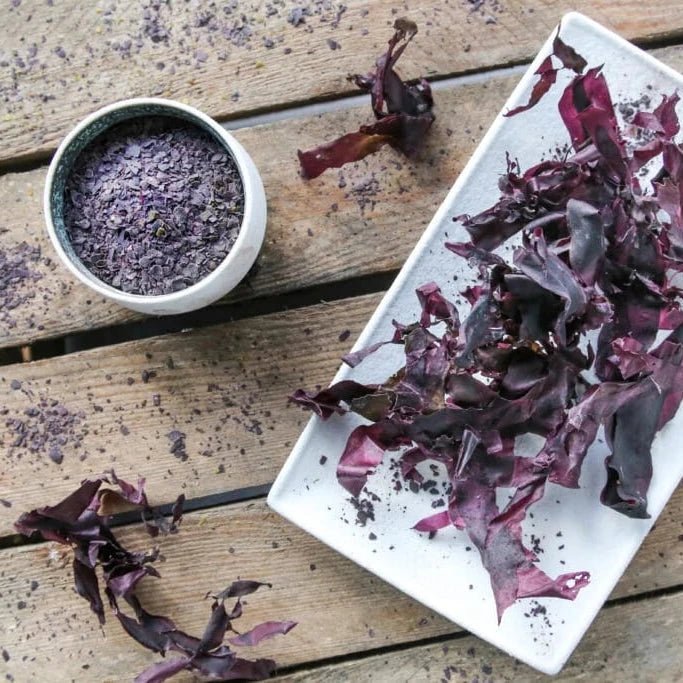
This is the earliest direct mention of dulse used as food, but if you look through the laws and documents, they tell a clear story of seaweed being a valued resource – especially dulse. In the early Icelandic law code Grágás, it’s important enough to legislate around: people were allowed to eat berries and dulse found on someone else’s land, but taking it away from a farm without permission carried a fine of three marks. Land charters from the period go further still, recognizing “dulse beaches” as valuable farmland in their own right.
According to food historian Ole G. Mouritsen, Vikings would eat fresh dulse baked into bread, and dried, salted dulse as a snack. For a proper meal, it might be mixed with butter or lard and served alongside dried fish, potatoes, or turnips; or cooked into milk or porridge; or worked into bread dough to stretch the flour further.
Mouritsen also states that Norwegian Vikings carried dried seaweed as provisions on long sea journeys. Dried seaweed is light, salty, keeps well, and is rich in vitamin C, keeping scurvy at bay – the perfect provision for a long sea journey.
The Black Salt
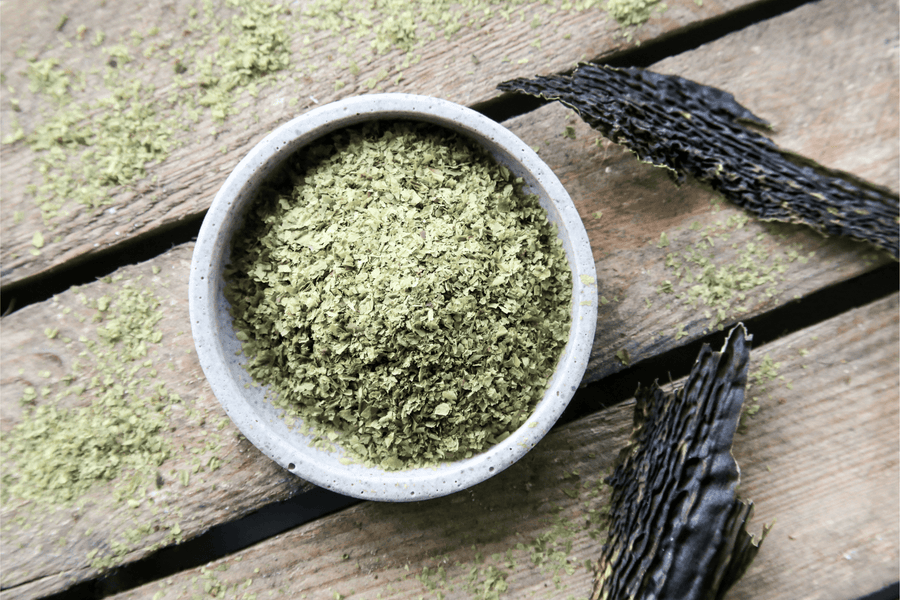
Perhaps the most solidly documented use of all is the black salt. Mined salt could be hard to come by, and boiling ocean water for sea salt was energy intensive, using precious firewood. The Vikings would instead gather certain types of seaweed, and burn it until it was salty ash; a dark, mineral-rich salt that could be used to preserve food, given to animals, or – in a pinch – used to season their own meals.
The older Gulating Law (one of Norway’s oldest law codes) includes a telling clause: a tenant farmer was normally forbidden from stripping and selling birch bark, except if he needed the money to buy "svarta salt", “black salt.” Salt was even more a necessity for life then than it is now, and as charred seaweed salt could be burned all along the coasts, it was seen as a basic necessity for survival during hard times.
This wasn’t a one-off, local curiosity. A 2026 archaeological study mapping charred seaweed finds across the North Atlantic found evidence of seaweed salt-making along all the traditional routes used by the Vikings, and in the settlements they founded – in Norway, Shetland, the Faroes, Iceland, Orkney, the Hebrides, Ireland, and both Norse settlements in Greenland. Wherever the ships went and the farms took root, the remains of seaweed burning show up in the ground. Salt-making from seaweed was, in other words, a genuinely North Atlantic–wide Norse practice.
Seaweed used for trade
Dulse wasn’t just foraged for personal use; it was bought, sold, and fought over. Two sagas from the Sturlunga saga collection, Þorgils saga ok Hafliða and Sturlusaga, both mention dulse specifically as a traded commodity. These sagas describe events from the twelfth and thirteenth centuries and are considered contemporary, reliable sources for the period – not the romanticized retellings the word ‘saga’ might suggest.
Seaweed as fertilizer
Alongside food and salt, seaweed also went straight back into the ground. Both burned and fresh seaweed have been used as fertilizer all across the North Atlantic, because of their high nutrient and salt content.
“The nutrients and alkaline salts present in seaweed have led to seaweed being highly valued for the enrichment of nutrient-poor, acidic soils in coastal Scotland, the Channel Islands, France, Iceland and Norway…”
— Dawn Elise Mooney PhD, Museum of Archaeology, University of Stavanger
“Charred Fucus-Type Seaweed in the North Atlantic: A Survey of Finds and Potential Uses”
A charter from Icelandic Vatnsfjörður records the church’s ownership of “seaweed beaches” as part of its resources – both the wild-growing seaweed and that washed up on shore was a valuable soil amendment for farmland, valuable enough to be named explicitly in a property record. A later charter notes that during a local shortage, seaweed for fertilizer had to be brought in from elsewhere – which tells us plainly that farms depended on a reliable seaweed supply to keep their fields productive, not just their livestock fed or their larders stocked.
In metalworking and as fuel
At the Viking Age site of Vatnsfjörður in Iceland (the same farm named in the charter above, centuries earlier in its life as a working Viking Age settlement) archaeologists found other charred seaweed remains used in the smithy, which experimental archaeology has since explained. Burned seaweed alone doesn’t get hot enough to smelt or forge with as a stand-alone fuel, but its ash works well as a flux in ironworking, helping molten metal flow more cleanly during welding.
Seaweed also supplemented ordinary wood charcoal as a heating fuel, prized for burning with an unusually bright flame through the dark Icelandic winter.
Closing
While the Viking age is ancient history, in a way it still continues. The same shoreline that gave a Viking-age tenant farmer his “black salt,” and gave Þorgerðr the dulse that broke Egill’s grief-fast, is the one we still walk today, gathering seaweed just like them. By sharing information and ideas today, hopefully we can bring seaweed back into daily life, and create new traditions that combine the past with the present.
Sources & Further Reading
- Egils saga Skallagrímssonar — Icelandic Saga Database, English translation
- Mooney, D.E., Guðmundsdóttir, L., & Prado, S. (2026). “The changing fortunes of seaweeds in the North Atlantic from prehistory to the present day.” Journal of Island and Coastal Archaeology. tandfonline.com
- Mooney, D.E. (2021). “Charred Fucus-Type Seaweed in the North Atlantic: A Survey of Finds and Potential Uses.” Environmental Archaeology, 26(2), 238–250. tandfonline.com
- Norseng, P. G. (2024). “The Use and Production of Salt in Eastern Norway to ca. AD 1600,” in Culinary Heritage. academia.edu
- Mouritsen, O.G. (2013). Seaweeds: Edible, Available, and Sustainable. University of Chicago Press.
- Siebrecht, M. (2013). “Seaweed, Swords and Smoke: Assessing the practical significance of seaweed in a metalworking context during the Viking Age.” MA thesis, University of Aberdeen. academia.edu
- Brute Norse — “Seaweed: An Authentic Viking Age Beer Snack”
- Lofotr Viking Museum / Borg longhouse — Wikipedia, History Hit
- Clément, A. Sort Salt — Udsigt over Tangsaltets Historie i Danmark og Norge.

With a background in design and branding, Johannes also enjoys writing about all things Seaweed, with a preference to historical or scientific angles. He lives in Lofoten with his wife and their two dogs.